

A Week of Time-Keeping
An experiment this week to answer "Where did all the time go?" for Get Off Your Phone February

Week 3 of Get Off Your Phone February is upon us, dear friends, and for this week, I am inviting you into a 5 day experiment of time-keeping, aka Time-tracking. I’ve done this before, and I’ve often read about it in different readings I’ve done about ADHD treatment as a psychiatry trainee, and think it might be a very useful way for us to learn about how we use our time in line with our values this week.
Why Keep Time?
The history of time and our modern perception of it is a long, winding tale which I won’t get into, but which the book Four Thousand Weeks: Time Management for Mortals will (and I highly recommend it1). Time, as we now know it, has not always been perceived in such a concrete way. Though there have been sundials2 and other ways of more irregularly gauging time, the evolution of science and technology made keeping time in reliable increments a needed tool. Thus, clocks and measurement took time and made it into a some-thing rather than an omnipresence.
All of this is related to our very modern problem of time, and finding it frustratingly slippery and spent too quickly. Though this concern preceded smart phones and apps like TikTok, I think especially Millenials and Gen Z struggle now with a sense of their time being stolen alongside their attention (and, likely Gen Alpha, but time…will tell). There are very few of us who have not had the experience of plopping down on the couch after work, after you put your child down to sleep, or after a long day of classes at university and intending to spend just a brief interlude on our phones before getting back to what we had planned for the evening. Suddenly, it’s 90 minutes later, you feel zapped of motivation, and inertia tugs on you like quicksand pulling you back into the allure of Excess Internet Consumption.
In this month of small moments of getting off of our phones, getting mildly uncomfortable, and asking how and why we want to use our technology, it would do us well to take a small, curious, and non-judgmental account of where our time is going. If busy-ness and overwhelm are pushing down on us, then an important way we push back is by actually making an audit of why we keep running out of time before our day of tasks and pleasures are complete.
Time Audit: Our Five Day Experiment & You Will Be Kind to Yourself Or ELSE!
Most of you know I believe in a dialectic approach to life, as we say in Dialectical Behavioral Therapy, and broadly this means believing that the two sentiments can be held by us internally at the exact same time, even though they appear paradoxical:
I love you, just the way you are.
Something might need to grow or change for a better future.
When it comes to my own relationship with screens and media overconsumption, this means I can have all the empathy I need for my current screen hours metric, I can see the good I want to continue to have from the tools of screens and social media, AND I can say I would like change. I don’t find shame to be a useful longterm change strategy, and this is especially true given something like screen use that helped us connect, create, and get through a pandemic together, and even teens recently find it helps them express creativity3.
Putting this together, our experiment this week will be a mindful approach to just noticing where we are, and how that is or is not in alignment with what brings us pleasure, what is useful to us, and what aligns with our values. Similar to exercise, connection, or a wholesome diet, our screen use does not need to be perfect. Many of us feel a real and at times concerning distance between where we are now and where we would like to be, and with a gentle approach we can try to decrease this distance.
How I Will Keep Time: Physical Journal Version
Because I am more drawn to and enjoy more physical journal and commonplace book keeping, this experiment will play out in a 5 day time-tracker in my moleskin notebook’s pages. If you would prefer digital, there are many versions online. Here’s one from an organization around ADHD, but it’s still a general time tracker.
Here’s how to set it up on any physical, lined paper you have:
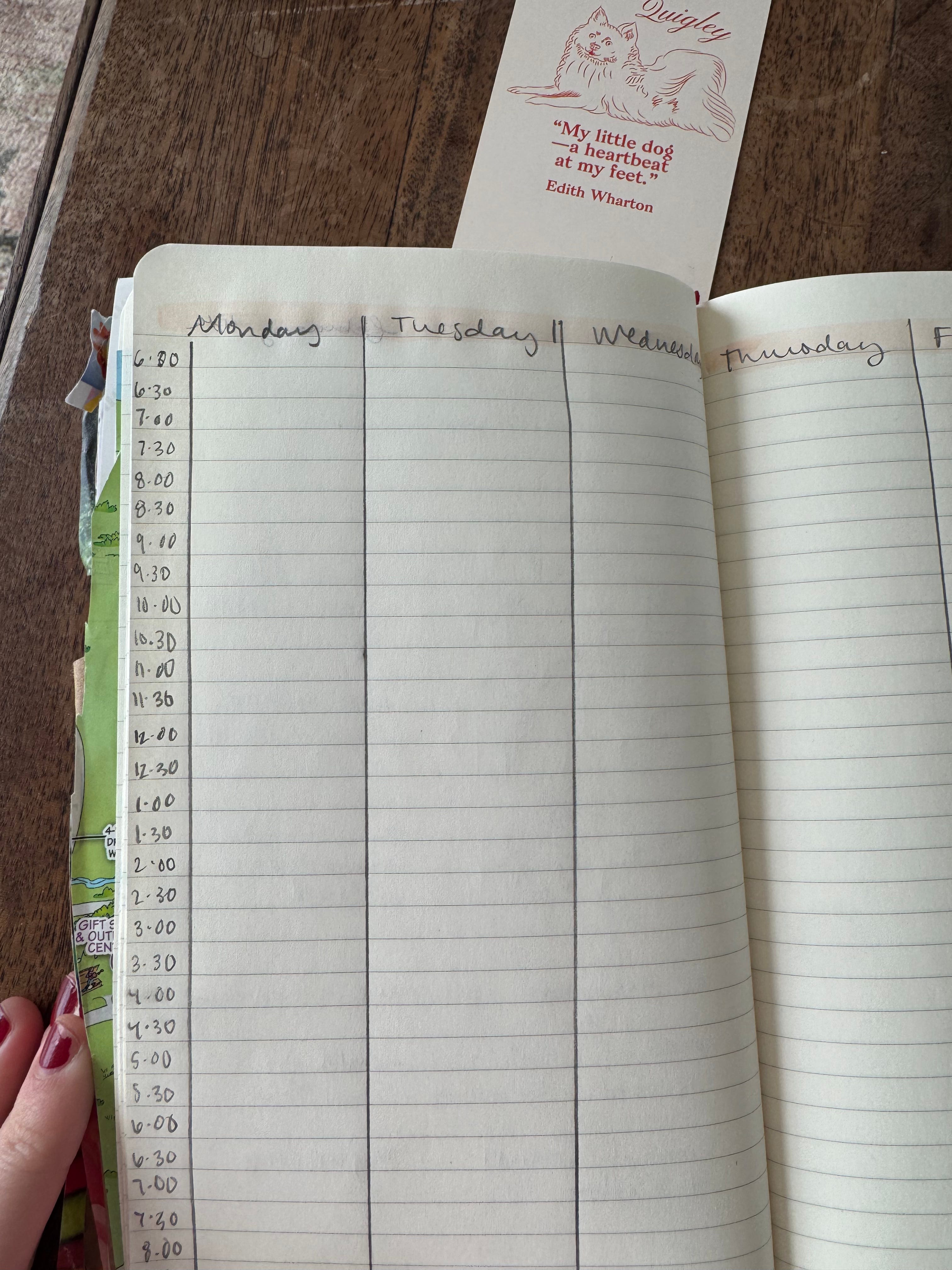
Mark out 5 or 6 columns for each day of the experiment. I will start today, Monday, but may go through at least part of Saturday, as I am starting this one mid morning.
Use the hours you’re most often awake for this. I’m doing 6-10, as that’s my usual hours on weekdays. Because my page has space for it, I’m doing 30 minute intervals. I think this lets me have some granularity without too much specificity that it becomes overwhelming.
During each day, a couple times, fill in how that half or third of your day went. That’s it for during the day. Try not to fib to yourself.
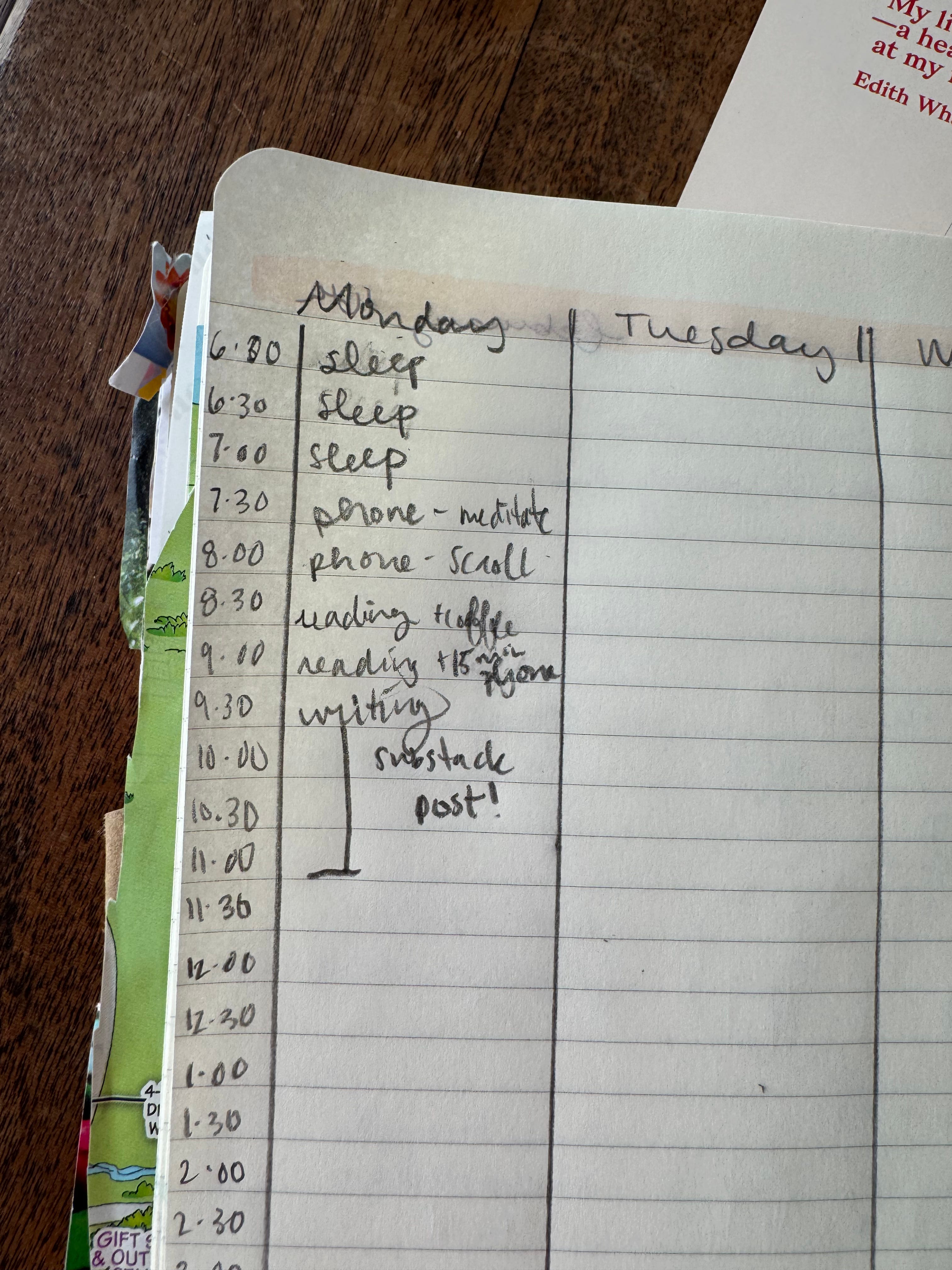
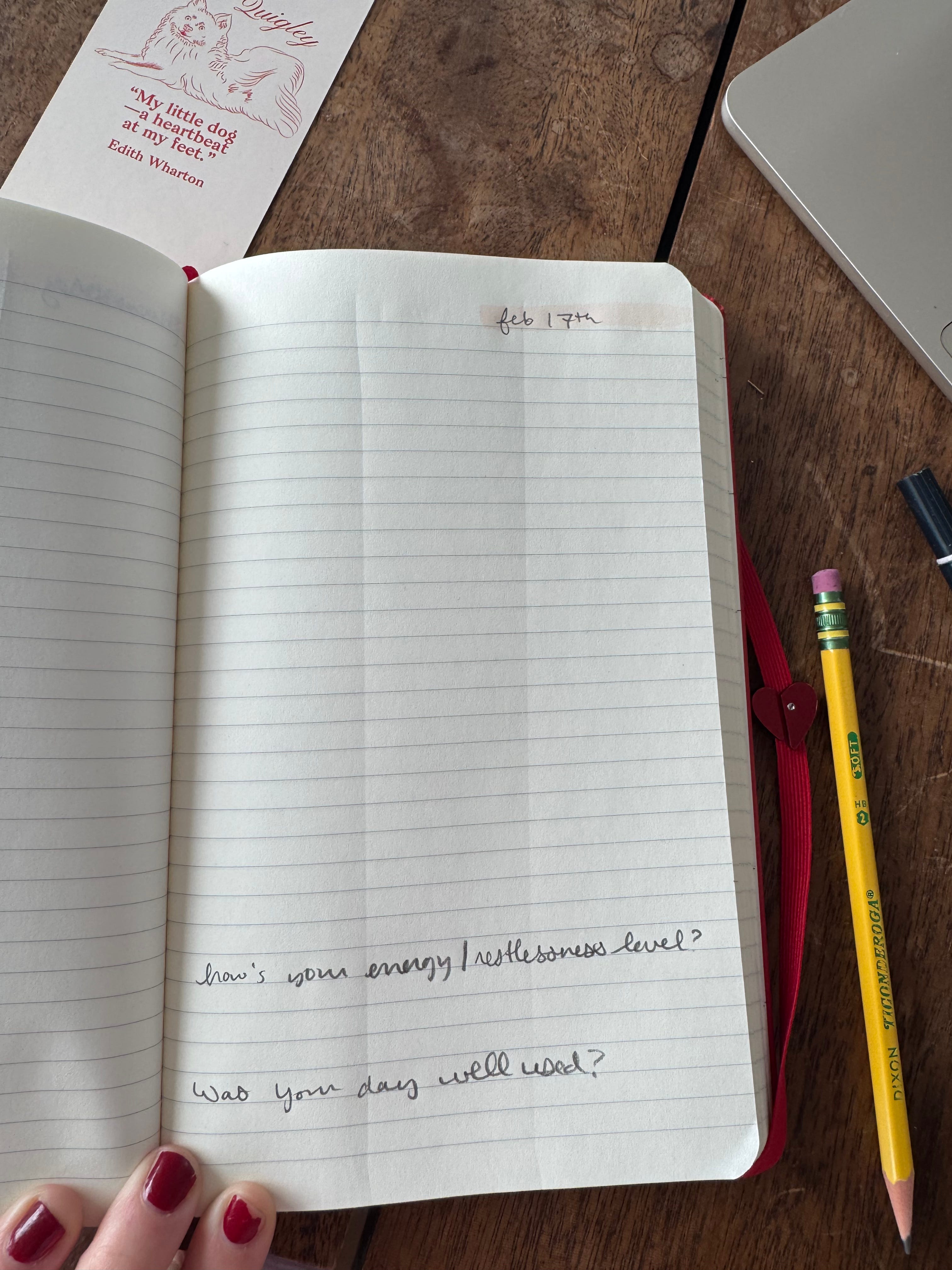
At the end of each day, look through where your time went. I’m asking myself these two questions to reflect on with the data at the end of each day.
REMEMBER I TOLD YOU TO BE NICE TO YOURSELF AND CURIOUS.
At the end of this day, what do you think your energy and stress has been like today? Do you feel pleasantly tired, exhausted in a not-fun way, overwhelmed, or restless, like you didn’t move or pleasurably use your mind as much today?
Was your day, according to your general ideas of it, well used? How so? How not as much (GENTLY NOW!)?
At the end of the week, on Friday, I’ll show you how I go through and see if I can find patterns or habits.
My Hopes for The Week
In the chat, I’ll be checking in each day, likely closer to the end of the day, and we will talk about how this experiment is going. My hopes for myself are just to learn more about where I am in terms of screen use, and how far OR not far I am from what I consider a balanced approach.
One of the reasons I’m doing this in a low-tech way is because I don’t find the screen time metrics very helpful, and I don’t want this data auto-gathered. In mindfully gathering this information myself, and taking brief and then longer moments to reflect each day, the data becomes more memorably to me. In doing it myself, I actually learn more. Additionally, If I spend two hours on screens writing or reading articles that I’m citing in a piece, that is 100% in line with how I want to use the internet, but it still is “screentime.” Collecting this myself makes me look in a hopefully more accurate mirror so that I might know what it would feel good to change. Sometimes with all the discourse about social media and screen use it can become easy to conflate all time online as bad bad bad. Yet, you may be closer to how you want to be online and off than you think, and this experiment holds space for noticing that, too.
Let me know if you have any questions in the comments below, or in our chat this week. I’m excited for us all to learn together where we are, what we are already doing well, and where we would like to go.
Thanks for your attention.
xx,
Margaret of Bad Art Every Day

https://www.scientificamerican.com/article/a-chronicle-of-timekeeping-2006-02/#:~:text=ACCORDING%20TO%20archaeological%20evidence%2C%20the,cycles%20of%20planting%20and%20harvesting.
https://www.pewresearch.org/internet/2022/11/16/connection-creativity-and-drama-teen-life-on-social-media-in-2022/