

“You must not ever stop being whimsical. And you must not, ever, give anyone else the responsibility for your life."
Mary Oliver May Week One: Combining Whimsy & Reality

I write to you all from the first burst of actual spring in Cambridge, Massachusetts. At my desk, I sip a sweating homemade iced coffee, and the tacky suncatcher on my window arches rainbow beams across my bed.
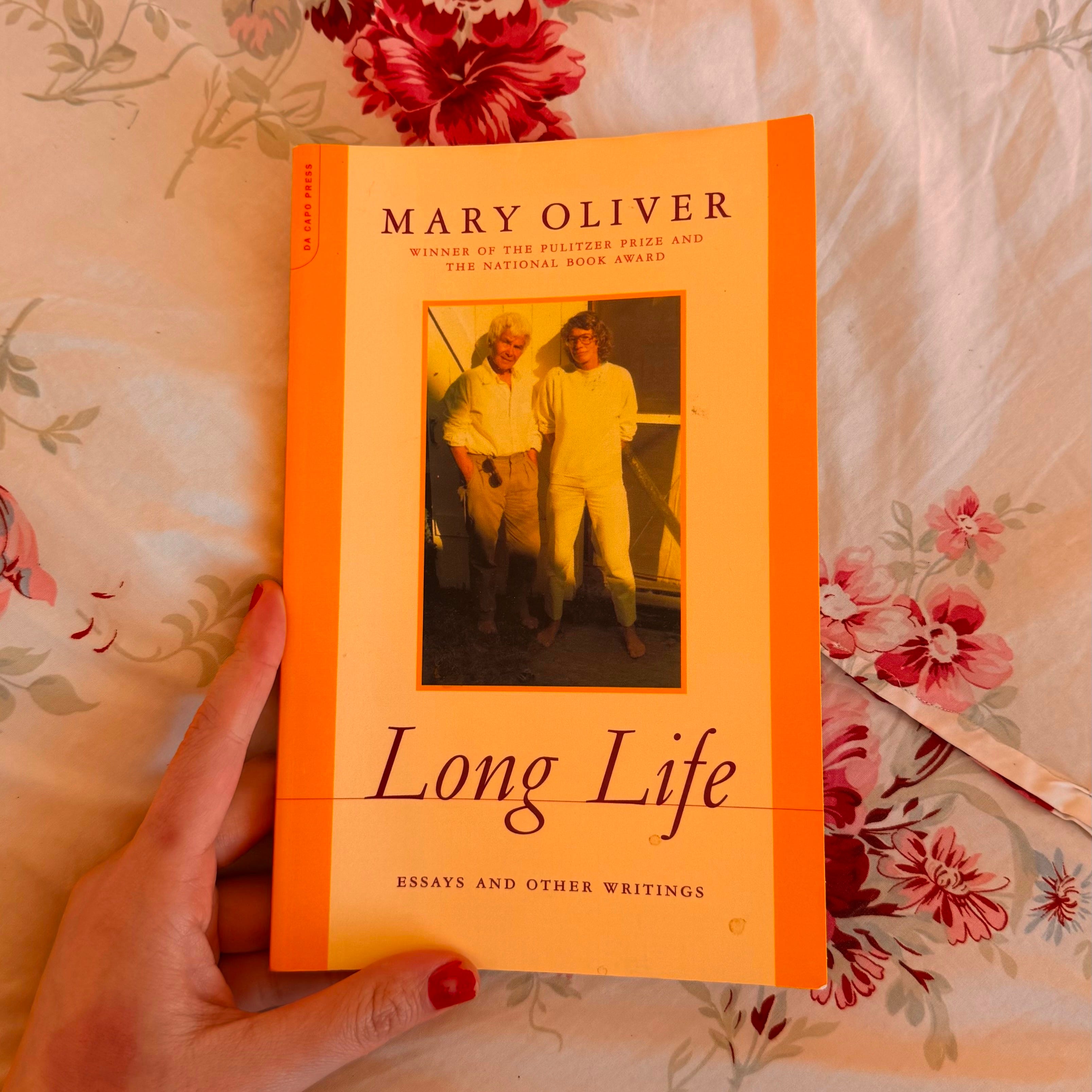
And I get to write today about one of the patron saints of my life: Mary Oliver. Welcome to week one’s mini journal for year two of Mary Oliver May.
Like others, last month I wrote about my disinterest in the growing tide of the whimsy aesthetic. Whimsy is something that I detest being commodified because it seems like commodification is the exact opposite of the spirit of being whimsical. Being whimsical is often akin to being a bit weird but not caring, as one was doing what one uniquely enjoys. I’m not against anything that helps people try new ways of being playful or creative, and if it had gotten swept into a full on trend online, I wouldn’t have minded it. But now, I see so much on Substack and TikTok that has become a coherent costume of what it looks like to be whimsical, and often it looks a lot like all the aesthetics that came before, just with a new set of props.
Someone who knew and lived in a whimsical and playful way was certainly Mary Oliver. You listen to her On Being interview from 2015, and you can hear the mirth in her voice even there. What you learn as you dig into Mary Oliver, her writing, and the fullness of her life is that at least a portion of her stance in deference to the beauty of the world comes from, as she says in the podcast episode, being saved by beauty in Nature in childhood. While it may be easy, as she says, for folks to romanticize her writing as a nearly fairyland creature roaming through the woods with her notebook and pencil, there is much that drove her into the woods that was not romantic. Even in her idyllic seeming life she later revealed in her older years, she was not able to live openly with her partner throughout their relationship.
Perhaps I love Mary Oliver’s writing for the same reason I loathe the current iteration of whimsy: it sees the world in shades of pink but it does not shy from the darkness. In other words, it is real without sinking into pessimism. It holds the tension of both. This poem, by Ellen Bass, frames the idea well I’m trying to speak of:
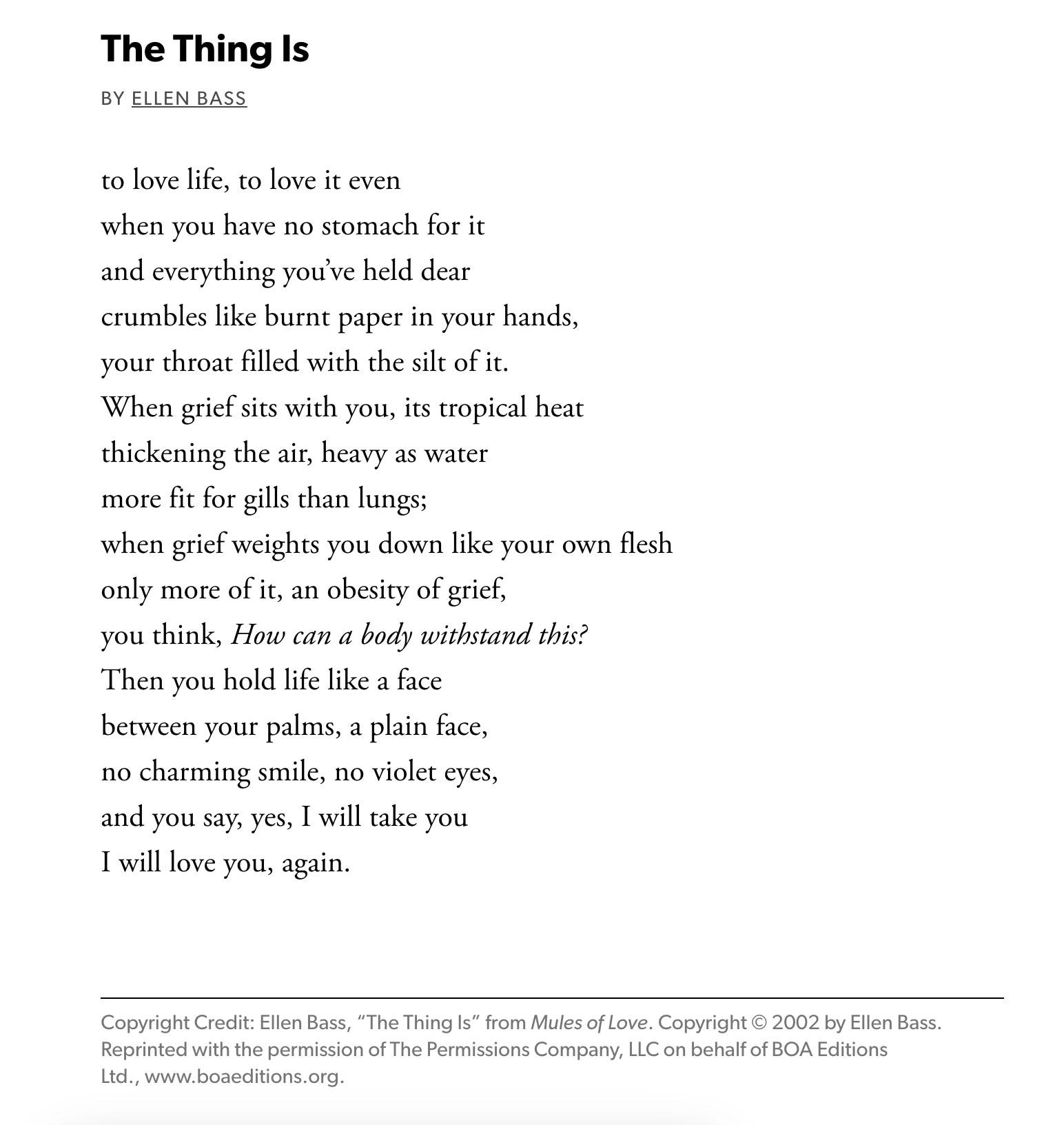
What more do we need right now than an ability to see the darkness in the world while also holding onto the glimmers of joy a newly born cherry blossom brings? To understand Mary Oliver as a silly or naive romantic is to miss the point entirely. Mary Oliver writes from a place of knowing darkness and never denying it, while holding a spark of hope throughout.
“You must not ever stop being whimsical. And you must not, ever, give anyone else the responsibility for your life.
And now my old dog is dead, and another I had after him, and my parents are dead, and that first world, that old house, is sold and lost, and the books I gathered there lost, or sold — but more books bought, and in another place, board by board and stone by stone, like a house, a true life built, and all because I was steadfast about one or two things: loving foxes, and poems, the blank piece of paper, and my own energy — and mostly the shimmering shoulders of the world that shrug carelessly over the fate of any individual that they may, the better, keep the Niles and the Amazons flowing.
And that I did not give to anyone the responsibility for my life. It is mine. I made it. And can do what I want to with it. Live it. Give it back, someday, without bitterness, to the wild and weedy dunes.”
From Upstream: Collected Essays by Mary Oliver
Luckily or unluckily, living this way is a constant balance. It is never achieved completely, nor finally, until we are done with this life. This month living along the themes of Mary Oliver’s work (and her life) means making a choice each day to be present, to see the world of Spring (or Fall for my readers on the other side of the world), and to not numb ourselves away. It is to spend a month in which each day we try to attune our attention to the wilderness without and within, even when we are not really even sure what we are listening for. It is taking our bag and our notebook and maybe our iced coffee and spending some time in the sun, with others, and off our screens some days, and being playful and relaxed other days to enjoy a game or a meme on our phones.
Welcome to week one. Below, find five journal prompts with some baked in activities. And remember—the point of this month is to let yourself ponder this theme, but leave enough freedom to roam and play with it!
★This week is free for all subscribers to enjoy as a gift from me to you as we start May! As usual, upcoming weeks articles and weekly journal prompts will be for paid subscribers. Consider supporting my work here and across platform by becoming a patron for $8 a month! Regardless, I appreciate the time and attention you spend here ★
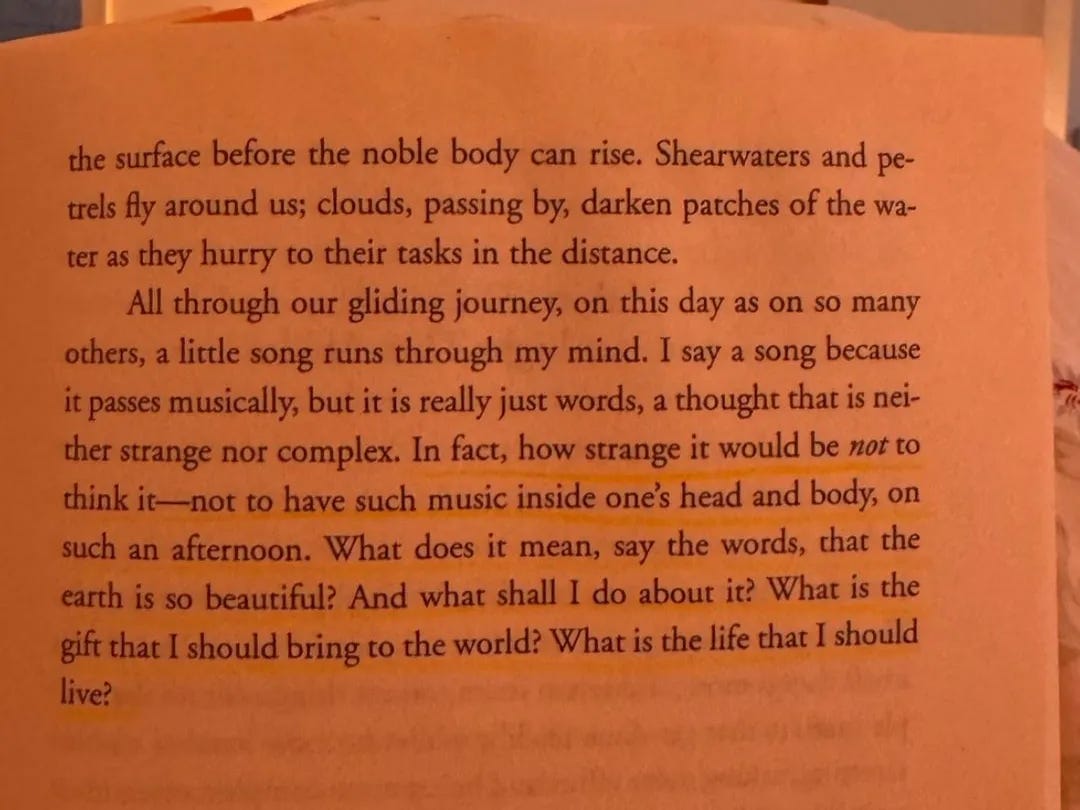
Week One Journal Prompts
★ Where does wonder live in your life? You may have to time travel to an earlier time in your life to re-find it. Mary Oliver was frequently writing while walking through Provincetown, Massachusetts in Cape Cod, where she lived. She was tracing old but ever changing paths and tides, and it appears from the outside as a perfect sort of work and play. Routined, yet open to spontaneity. Trusting that the poem will come to her to write down, as a scribe. Wonder and play were often linked in childhood: what did you get lost in? Where were you amazed? Are there any shimmers of that part of you that bolt through your adult life at times?
★Whimsy and responsibility are not opposites, but in adulthood and especially right now in the world, it can feel like one must be sacrificed for the other. We know there are people who balance this well. Who is a mentor for you of someone who has remained silly, alive, and responsible to tending their life? This can be a second grade teacher, a fictional character from your favorite book, or your mom. The main thing is to find what is resonant that might be trying to communicate something to you about how you’d like to live your life.
★ Mary Oliver writes about and lived in nature in a relational perspective, versus through a lens of deadness. She carried a sort of relatedness to nature that was inspired by transcendentalists who believed that one way of knowing and worshipping God was through nature. It resembles as well the way of being and seeing as practiced by some indigenous peoples—ie that land is not something to own and concur, but to live with and care for as it cares for you. What is your view of how you relate to nature? Has Nature ever supported you, quietly, through a difficult point in your own life?
★ Mornings were a ripe time for finding glory for Mary Oliver, at least by her writing. She had quite a routine, as well, which she kept regular with. She viewed by usual with a routine as the way that she would be attentive enough to catch the poems that wanted to be written. What habits or simple routine would you like to live out this month? How could you track it? And how can you make it both responsible and whimsical to practice?
★ Is there a regular time in your day where you can connect with non-human living beings? This could be a walk with your dog, hanging out with your cat 5 feet from you because he has excellent boundaries, or a walk at sunset. Where might you be able to regularly connect with the changing time of spring and practice a mindfulness with it?
Take care, and have fun!
Margaret of Bad Art Every Day
P.S. Looking for more themed journals with daily prompts and ideas? Check out my etsy shop for my digital journals from prior seasons for a downloadable, self-contained resource.
I like that Mary Oliver's definition is seeing the beauty of life while also acknowledging that darkness exists. I feel like it's not a good thing to stay too much on either side of the spectrum.