

Weekend Reading & A Recipe: My favorite media of the week for your weekend morning coffee time and a recipe for your kitchen
Staying with the rising desire for slowing, the value of space, and the angel food cake I learned to make at 13

It’s a wintry weekend in Boston, to the extent that the top layer of the Charles is frozen with long sheets of ice topped with snow. I remain committed to my walking at least half the week, with the assistance of a double layer neck scarf, mittens, and a trusty long, insulated coat. The sun still shines, and my coffee or peppermint tea awaits to warm me, like hot cocoa once did for me as a girl coming in from playing in the snow.
C.S. Lewis once said, “Eating and reading are two pleasures that combine admirably.” And, given he is a bookish Brit, he has much to say about his routine with writing and tea. As for myself, winter weekends are for brief jaunts into nature (if possible), a cozy friend’s home or restaurant, and long mornings in pj’s with coffee, tea, and a homemade baked good of some sort.
I present to you here some supplies for that sort of weekend: my favorite reads of the week, mostly here on Substack, my fiction and non-fiction books of the week, and a recipe for a cake I view as somehow perfect for the month of January, especially when it snows: Angel food cake.
Books on my coffee table
Non-fiction: We Are What We Eat: A Slow Food Manifesto by Alice Waters, which is small little book full of the principles of “fast food culture” and “slow food culture.” I’ve been tinkering with the ideas in it and how it applies to fast and slow media culture, as well. A piece on that will be up likely before the month is out.
Fiction: Deep winter is for a big, long, classic book. This year, it’s a re-read of Anna Karenina.
Essays for your perusal
'Yutori' for 2025, by Kana Chan
“Yutori is a noun that means having room to spare, not being cramped. Room to breathe. Rest. At its core, yutori translates to "spaciousness", and the concept extends beyond physical space, encompassing mental and emotional space as well.”
Nothing to say, by Sophia Efthimiatou
“Shared silences can also exist in isolation, between a writer and a reader, a musician and a listener, a filmmaker and a viewer, whenever, that is, there is a fusion of conscience. But they cannot exist in social media, however big the crowds there are. A fusion presupposes some sort of pause and by design such spaces are meant to eliminate pausing. For them to be successful they must maximize views within the minimum number of seconds. We are encouraged to either claim our space in them by projecting aggressively, or to continuously dismiss what we are being offered with a swift swipe. We cannot truly share silence in any part of them. In fact, no matter which side we belong to, projector or consumer, we are being rendered more resistant to reception.”
The Body is a Doorway, by Sophie Strand
“What if the shape of your wounding, the exact flickering silhouette of your hypersensitivity, was the shape of the doorway into another being’s pain and experience?”
And A Recipe: Angel Food Cake
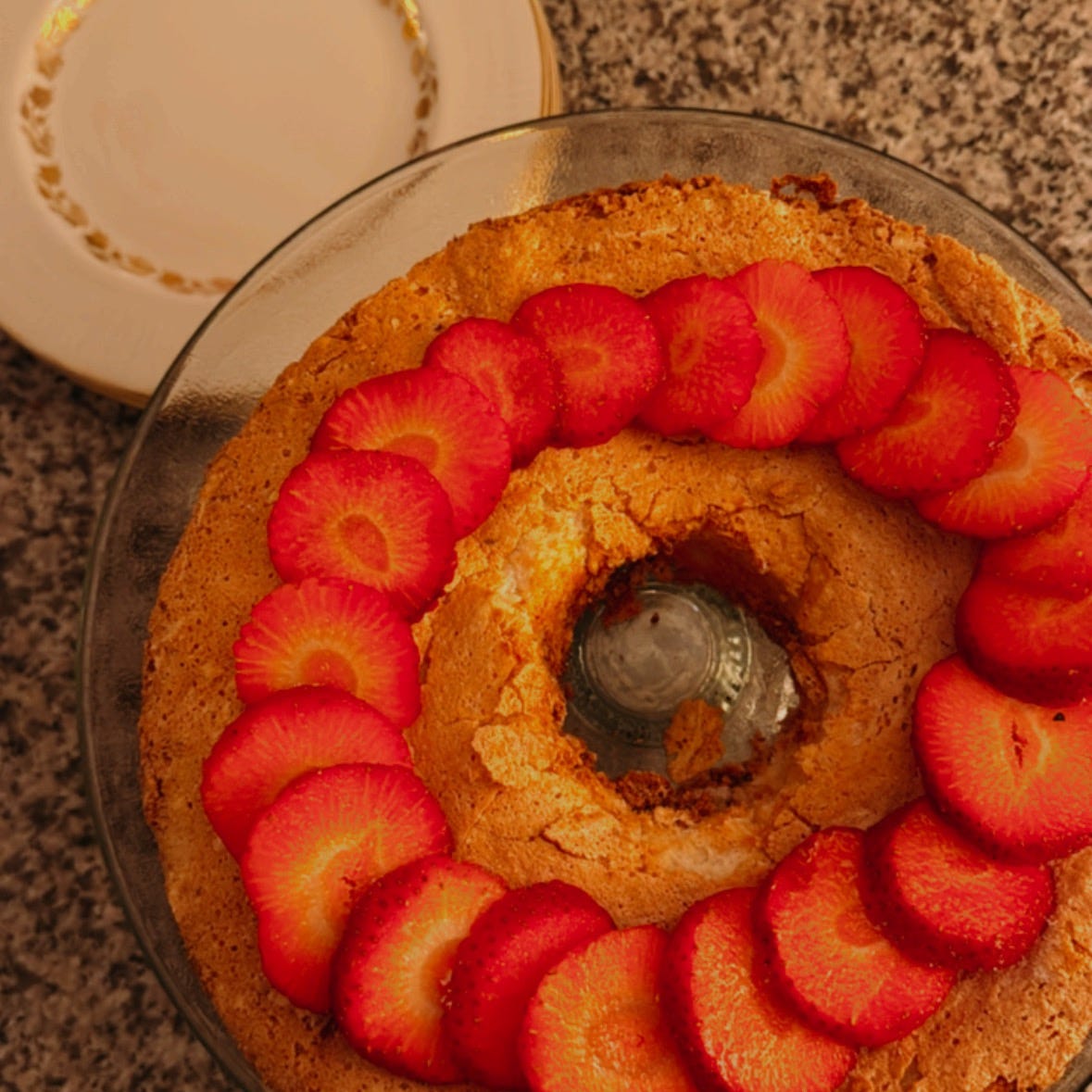
The recipe I use is unedited from the original that I learned when I first started making these at 13 years old. It is from the early 2000s edition of The Better Homes and Gardens Cookbook, and that single recipe with tips on the working with egg whites and meringue technique of it all can be found here.
This cake, beyond being delicious and a feat to those you bring it to, is fluffy, sweet, and simple. The cake itself requires only 6 ingredients, but a lot of tender care and time. Separating egg whites carefully so not a drop of the fat of the yolk can mess with the formation of the structure of the cake, the letting the cake rest upside down, and the careful choice of your fruit topping and chopping for the finish. I made this on New Year’s Day, and we had champagne and cake, and it was a delight.
I hope you all have a lovely weekend, and are taking a moment offline to place your attention on something that nourishes you. It is part of the long work of advocacy, community, and care that we keep in the mix things that are not shocking or urgent, so that our long work can be sustainable.
xx,
Margaret of Bad Art Every Day
Had to unsubscribe because of anna karenina after this. Wild to me that educated Americans still cannot get out of their russian loving phase and see that literature and the regime that borne it as what it truly is — targeted erasure of national identities of many nearby countries and imperialism. I am sure you cannot name even one novel by people from countries who have been executed by the regime and whose language has been forcefully erased (like Belarusian)