

Tending to The Last 75 Days
Spending the end of the year in balance and kindness through 75 Grow

Do you guys get tired of me writing about the same thing over and over, month after month? I don’t tire of writing about it, but maybe that’s because it is what I’ve chosen to spend my professional life doing. I have and do still delight in finding out what makes up a person’s daily life, and what they wish it was instead. While the large existential questions of change are equally important, to me they are only equally important—not more important.
And so I write again and again about 75 Grow, and about focusing our attention just a bit more on things we can change versus things we cannot (or, we won’t see change anytime soon, though our efforts continue). I’ve found in my life and in my line of work that the mundane take up most of it—going to the grocery store, flossing, doing the dishes, going on a jog. They can be a source of annoyance, and at worst a source of overwhelm and then a grey sort of suffering. They will always be a little bit annoying, but they can also be a daily practice of creativity, problem-solving, devotion, and even joy. As a psychiatrist and therapist primarily working with people in care-giving roles (interpersonally and professionally), big insights are often the crown jewel in therapy. They are not the gilded crown’s frame. The quotidian done well—these are the background that are where the big insights and big purposes are painted on top of. Without the background, simple details, the large insights or big dreams often fail to come to fruition or to satisfy our desire for meaning.
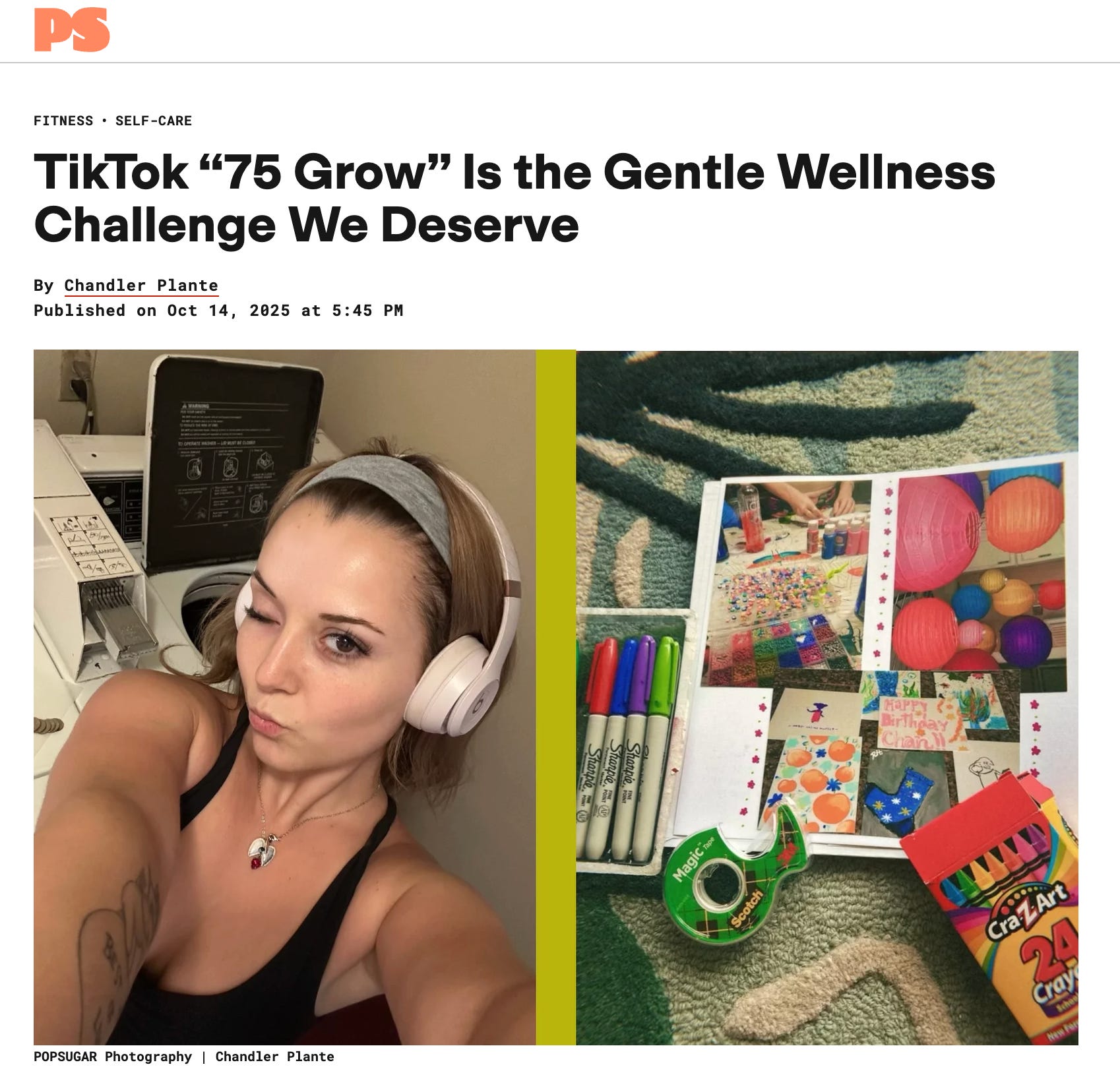
I was recently interviewed to talk about 75GROW on Popsugar, which yes was a dream for my inner 16 year old who read all the beauty blogs. You can see the interview and the writer’s plan for 75GROW here. It is a joy in real life, in my own life, and in virtual life to see a framework that helps me help other people. It also becomes a self-sustaining cycle as I then get motivation and ideas from seeing how other people take the frame and make it theirs.
As we go into the final 75 days of 2025, including the slowing and darkening of winter, the glitter of holidays, and the eventual question a new year always poses, here’s five ideas about how spending these 75 days focusing on the three habits of movement, avoiding avoidance, and practicing creativity (M.A.P) might be useful (including my own intentions and hopes for what it will bring as I wind down the year).
1. Keeping promises to ourselves feels good, especially when they are promises of the right size.
There are the advocates for “floss one tooth” a la the book Atomic Habits. There are advocates for “big hairy audacious goals.” There is the mythology both that if you imagine and visualize and manifest where you’d like to be you’ll either somehow “use up the dopamine” in your brain and not have motivation, or it will make it bound and inevitable to happen. If any of the above work or have worked for you, great! As a psychiatrist and therapist, if it functions for you and doesn’t hurt anyone, I love it! But if the above have not helped you, here’s another option: a 10% scary practice.
When I talk or write about my “Avoidance Diaries” on TikTok and here, I often reference this, and it comes from my work in the OCD world in Exposure and Response Prevention (ERP), as well as my work with understanding executive function and organizational supports. In ERP, there can be many approaches, but the main thing is over time we put clients (collaboratively) in versions of the thing they have a phobia about or are avoiding to the extent that it’s causing issues in other parts of their life. 1% is usually not enough to feel proud of when you finish it, and bigger percentages like 50% or 90% can get perfectionists stuck in the cycle of being frustrated with their limitations, then overdoing it, then avoiding it, and repeat. So we do 10%—enough that it’s unpleasant and a little scary, but not so much that we are making it really awful as an experience and something you need to recovery from the rest of the day. This—when thinking about our habits for these 75 days of 2025—are what I like to think of as right size promises.
2. Winter Arc but actually the Arc is that you do things that are sustainably good for your mind to help with the seasonal blues (or go to a doctor for clinical level care).
This is where I say that lifestyle changes especially when done in isolation are not enough for mental health conditions, so see to clinical care if you need. But, for those not in the clinical level of depression in winter, there are things that help our brains and wellbeing. Movement (especially when done with at least moderate intensity for 20 or more minutes most days of the week) is great for our brains also, but also tends to be lacking in the colder months. Having a clean environment and reducing your procrastination anxiety ghost that hovers as you look at your dishes, your angry oil change light, and that one email you were supposed to send last week. Practicing creativity or play invited you out of the 5 pm darkness and sees if your imagination can be used for fun or doing something interesting at night instead of succumbing to scrolling every weeknight (some scrolling is fine and dandy though, don’t worry).
3. How you end can impact how you start.
I believe in starting over whenever, but I also know how a fresh 1st of the month or the year can unlock some special magical source of motivation for many of us. In this challenge, I don’t want you to ask how you’d like to look, appear, be seen as, or judged as on January 1st. I don’t want you to focus on the extrinsic—making yourself into another product that is observed and judged as its main function in life. The question I’m asking myself is—how would I like to live most days as I start a new year? How would I like to feel and tend to my emotions? What would good connection and healthful habits be like in my day to day? Living into the process is, as always, much more the point.
4. The holidays can be lovely and bright AND overwhelming and disorienting—simple habits can reinforce routine.
Holidays and winter are known to be times that trigger grief, nostalgia, complex family dynamics, and basically everything in between. Then, there is the indigestion, sleeping on a mattress in your aunt’s basement, and the cranky child (yours or someone else’s). All of these things can roll into a cluster of delightful memories and panic attacks, but one of the things that can help is continuing to have a smaller, travel-friendly version of routine. This will inherently need flexibility, but if you get in the practice of doing yoga a few times each week, maybe during Thanksgiving, you go to a class in your hometown or practice with your morning coffee before or after others are awake. Maybe you bring your journal, and offer to go get donuts one morning, and write a little bit about what you see or feel. The habits can be modified and moving like a river, but being able to still touch the foundation under you while in the chaos of the holidays can be a huge comfort.
5. These three habits are fundamentally habits of care and connection, and that is what the world and our local neighborhoods need right now.
As we go into short days of sun, long nights, and cold weather, it can feel natural to isolate and hibernate. I’m very much for slowing down, resting, and not trying to force ourselves to feel the same energy levels at all points in the year. This time of year is also one for kindness and care, given how difficult it can be. While you may wonder how this is relevant for self-development-esque challenge, consider this:
You move more, and as you go to a studio or gym or running trail, you slowly recognize friendly faces. When they aren’t present the Monday before Thanksgiving, you talk with them after they get back and hear about the very good pumpkin pie they had, and the not so good cold they got from their second cousin. You feel a little better in general with movement, and so your brain quite literally is better at listening and maintaining more energy through the day. Your wellbeing let you be there for them, and have more capacity to do so.
Avoiding avoidance makes you feel less overwhelmed all the time. You are less on edge. You are 10% less snappy. You don’t feel the need to rush, and you notice people a little bit more. Even if that is just not honking so quickly at the driver ahead of you who you later realize is a 15 year old terrified of learning how to turn left (this may just be me).
Practicing creativity is not just about learning how to do a Formal Art. It can be—it can also be spending the evening making a cake for the hell of it rather than scrolling, and bringing it into work for your friend’s half birthday or just because. It can be making a homemade card that turns out pretty cute for your sister’s birthday. It can be inviting people into a decorated and cozy apartment that you put your time and imagination into. This is play, and this is creativity done in connection. It is often what I think of most when I think of creativity and an “artful” life now.
Whether you’re joining this final 75 of the year or not, I hope this post invites you to slow down, and to ask how you’d like to spend this season. I hope you ask that with kindness, and with a tenderness to the parts of you that freeze up because they’re afraid you’re going to ask them to do one more thing even though you’re already overwhelmed. Maybe your challenge is seeing where you can ask for support or offload things for the rest of the year, or go easier on yourself.
Take care & take your time,
Margaret of Bad Art Every Day