

Make Exercise Fun Again: Power, Creativity, and Play
A deep dive and guide on why exercise is not fun for most women and concrete ideas to bring play back into your daily movement routine.

I am 31 years old, and this is the first time in my life I have ever considered the label of being “athletic” or “sporty” for myself. I don’t think I am very different than most women in this.
Did I play sports as a tween and in high school? Yes—but definitely not well. I played volleyball by mostly residing on the bench and making jokes with my also-benched best friend. I ran cross country and was definitely not breaking any records (but still loved the aspect of being in nature). The most I could say about myself growing up was that I was willing to try hard at sports, and accept that athleticism was never going to be the place where my strengths (literally and metaphorically) lived.
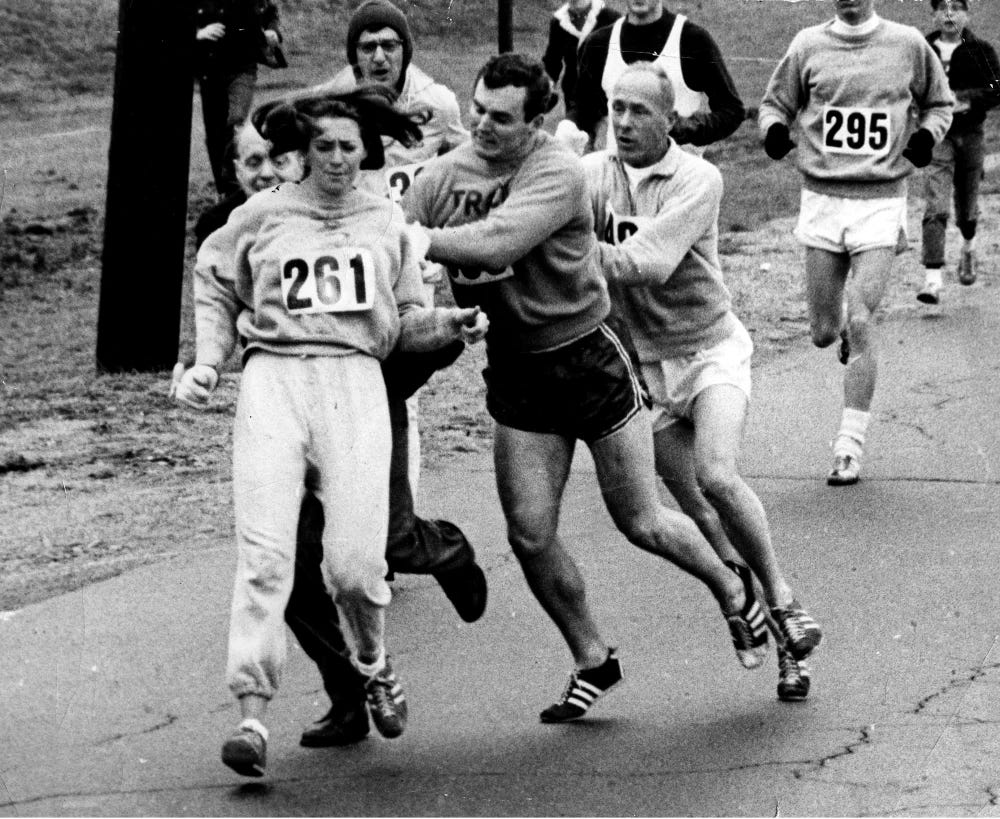
I am not particularly unique in this experience of my body, exercise, and athleticism. In fact, after reading more into the history of feminism, fitness, and women’s bodies1, my felt sense of my ability is the socialization all women receive, albeit with my generation coming on the scene 35 years after Title IX and therefore receiving more encouragement that women in prior generations. We see this language still today that pulls women out of sports and considering themselves as athletes:
“Don’t lift too much weight or you will get bulky (ie fear of living in even a somewhat larger body) or become intimidating. Men want cardio bunnies…”
Almost all language around beauty standards and public presentation require a relationship with movement that would increase daily work for women. If you sweat, and therefore need to shower and redo your hair, makeup, and styling, fitness becomes more than just the hour in the gym. Because men have way less beauty labor to perform to be viewed as acceptable in public, valuing exertion costs more and requires more planning and calculations for women.
Pay in women’s sports compared to men’s is abysmal. Women in sports from an early age all the way through professional leagues are seen as more masculine in a derogatory way while also being deemed as never being able to be skilled in a way that would matter as much as men in sport. This also comes out in sexualized harrassment, most often indicating that a woman interested in sports cannot also be interested in a romantic relationship with men.
It’s no wonder that it is therefore difficult for the modern woman to easily have a playful, joyful, and useful relationship with exercise, even as she pays hundreds of dollars a month to exercise daily. There are so, so many scripts we have inherited and left unquestioned that the casual daily exerciser is impacted by but may not have had the motivation that a professional athlete has to deconstruct.
In this piece about getting more fun in exercise again, my argument is that these scripts affect us “non-athletic” women, too. In understanding the sexist stories we receive about muscle, power, and movement, we move to not living by those stories any more. We find more freedom in our bodies (as pointed out by writers such as Audre Lorde and adrienne maree brown)and that liberation allows us more access to joy, pleasure, and empowerment. Making exercise fun and believing in your ability to become or be athletic, no matter your age, can bring so much into the daily life of women.
“Our bodies are the physical bases from which we move out into the world…ignorance, uncertainty—even, at worst, shame—about our physical selves create in us an alienation from ourselves that keeps us from being the whole people that we could be. Picture a woman trying to do work and to enter into equal and satisfying relationships with other people . . . when she feels physically weak because she has never tried to be strong.”
Our Bodies, Ourselves, by Boston Women’s Health Book Collective, 19702
Liberating Growth Mindset: Practice the ability to be something you thought you could never be.
I have a feeling that many of the writers and thought-daughters (aka reflective and creative women) who follow me here may have had similar strengths and weaknesses as girls. Some have had it all, but I suspect the creative and bookish areas of our schoolgirl lives were where we excelled, and P.E. class was something we either experienced shame or proclaimed disdain for (and honestly, often for good reason). This shame-disdain mix was certainly my experience of PE, and then sport became a place of effortful repentance in which I could try so hard (in the case of running, we were encouraged to push pace to the point of puking) to get to the point where I was not unathletic. The goals of mastery, expression, skill-building, connection, or fun were not ever a part of my movement practice until I got into my mid-twenties.
Exercise in your twenties, thirties, and beyond can be an entirely new world compared to how PE and childhood sports may have felt. For one thing, as you get older, less people exercise and, more importantly, as you get into your thirties and forties, exercise slowly becomes something of a daily medicine for many adults in more sedentary-style jobs. This change in the purpose of exercise and the culture around it (even compared to your early twenties, when solidcore and the gym feel like a way to prove your social and romantic worthiness to the dating pool) takes the pressure off. When the pressure is no longer there and you begin to practice a form of movement at a pace that feels good for you, the lesson of the tortoise and the hare becomes important once more.
When I was in my first year in residency in Boston, I began having low back pain. It was likely from increased stress, decreased sleep, decreased exercise, and standing in rounds for hours at a time in the hospital in varyingly odd formations. Because of this and my good health insurance, I went to PT and stuck with it for 6 months twice a week. Over time, the pain decreased and I learned about what contributed to my pain. More importantly, I also actually got stronger and for maybe the first time in my life finally understood how muscle grows and what that experience feels like. It is slow in terms of weeks but quick in terms of years. After this less, I then worked out 4 times a week with the strength training streaming program Evlo, which is run by three female physical therapists who also used to teach group fitness, and were tired of seeing injuries in themselves and their clients. (P.S. I was eventually on their podcast as to discuss body image and exercise as a psychiatrist who specializes in treating women). Through this, I learned that just because I had always been weak did not mean I always had to be weak. Cognitively from my lessons in medical school, I knew this. The actual embodied experience of being able to lift progressively heavier weights shifted something in how I thought of what movement could mean for me. Feminist leader Gloria Steinem also wrote about the radical change both she and other women experienced in pursuing strength:
““I come from a generation who didn’t do sports. Being a cheerleader or drum majorette was as far as our imaginations or role models could take us…That’s one of many reasons why I and other women of my generation grew up believing—as many girls still do—that the most important thing about a female body is not what it does but how it looks. The power lies not within us but in the gaze of the observer…For women to enjoy physical strength is a collective revolution…I’ve gradually come to believe that society’s acceptance of muscular women may be one of the most intimate, visceral measures of change.”
Exercise can do this for you too, Reader, no matter where you start and what stories you carry. You may be thinking, “Wasn’t this article supposed to be a fun listicle? Why is my inner 13-year-old who dreaded kickball day because she would be picked last getting activated right now?”
Valid! We will get to the listicle, but for exercise to be fun, it has to be safe. For us to play, we need our imagination unlocked and liberated both mentally and kinesthetically. If we feel no safety or agency, our ability to try is severely limited. If we don’t explain some of the stories we have inherited, it’s really hard to have compassion as we try something new because we will simply end up back in a shame spiral and disoriented. You may have experienced this before when you yourself have tried to enact a change in your daily exercise, health behaviors, or lifestyle.
Any way, onto our first listicle of three for this guide.
Ways to make exercise a daily practice of empowering parts of yourself you thought didn’t exist.
First, ask yourself what type of athlete (any gender, any sport, any time in history) most speaks to you. Let yourself roam with this or get very specific. For you, maybe it is Simone Biles, and the way she commands the floor and sets her limits to do her best. Maybe it is Tom Brady, and the way that he is so focused (sometimes too focused…) on his sport and becoming the greatest. Maybe, even, it is Zara Larsson who isn’t classically what comes to mind when you think of “athletics”…unless you count dance (which we should) and performance, and the ability to do concerts every night without missing a beat or losing her breath. If you could wave a magic wand and have the abilities of one of these athletes or one you choose, who would it be, and why?