

Looking for Generosity
Using the expanses of our imagination to expand the kindness we experience in the world, while still allowing ourselves to be an irritable sort

I write to you from a cross-country flight, and the person in front of me just decided to lean their seat back, which is well within their right. However, despite my cognitive knowledge of that fact and that I could also lean my chair back if I wanted, a sudden flare of irritation and annoyance took up residence in my chest.
How dare they? Why doesn’t anyone think of anyone else? Am I the only one who thinks before taking up more space or inconveniencing the person behind me’s experience? Maybe I shouldn’t bother, if no one else thinks about it.
Y’all. I know—I don’t sound particularly mindful or kind. Mind you, I did wake up at 4 am already grumpy, and thoughts and feelings like this are bound to happen and pass. However, as I continue to submerge myself in Mary Oliver’s writing, moments like this in the past few weeks have made me reflect on what it means to seek to see and stay with moments of generosity that exist in this world. Given the current pace and content of the news around political life here in the US, finding ourselves mindlessly consuming down every dark corridor of the internet is an very familiar pattern. What’s more, the way much of modern news, content, and tech is designed is with the intention to capture attention through tapping into salient emotion, much of which is negative emotion. Our brains do, after all, care about surviving more than they care about happiness, and therefore negatively charged emotions get us to stick to to our screens for longer. Marketers have made use of this psychology.
I think you know, Reader, that I’m not exactly a Kumbuya, “woo-woo” mindfulness sort of person—not at all. If my calming and comforting content on TikTok had you thinking that I was, one listen to my mental health podcast will disabuse you of this notion (we just finished season one, we are both psychiatrists, and we couldn’t make it through one episode without cursing…every episode is rated E…). When I think about Mary Oliver’s writing and the few times she was interviewed, I don’t really get the sense that she was innately very positive, either. I think she was devoted to paying attention as a practice, and to building a life that increased her ability to stay with the beauty of the natural and spiritual world. A practice of seeing beauty and having enough time to stay with it is not to fake an overly positive attitude or to insist on only pleasant emotions. Yet, it strikes me that this practice of Oliver’s is something active I could engage with in how I look at the world.
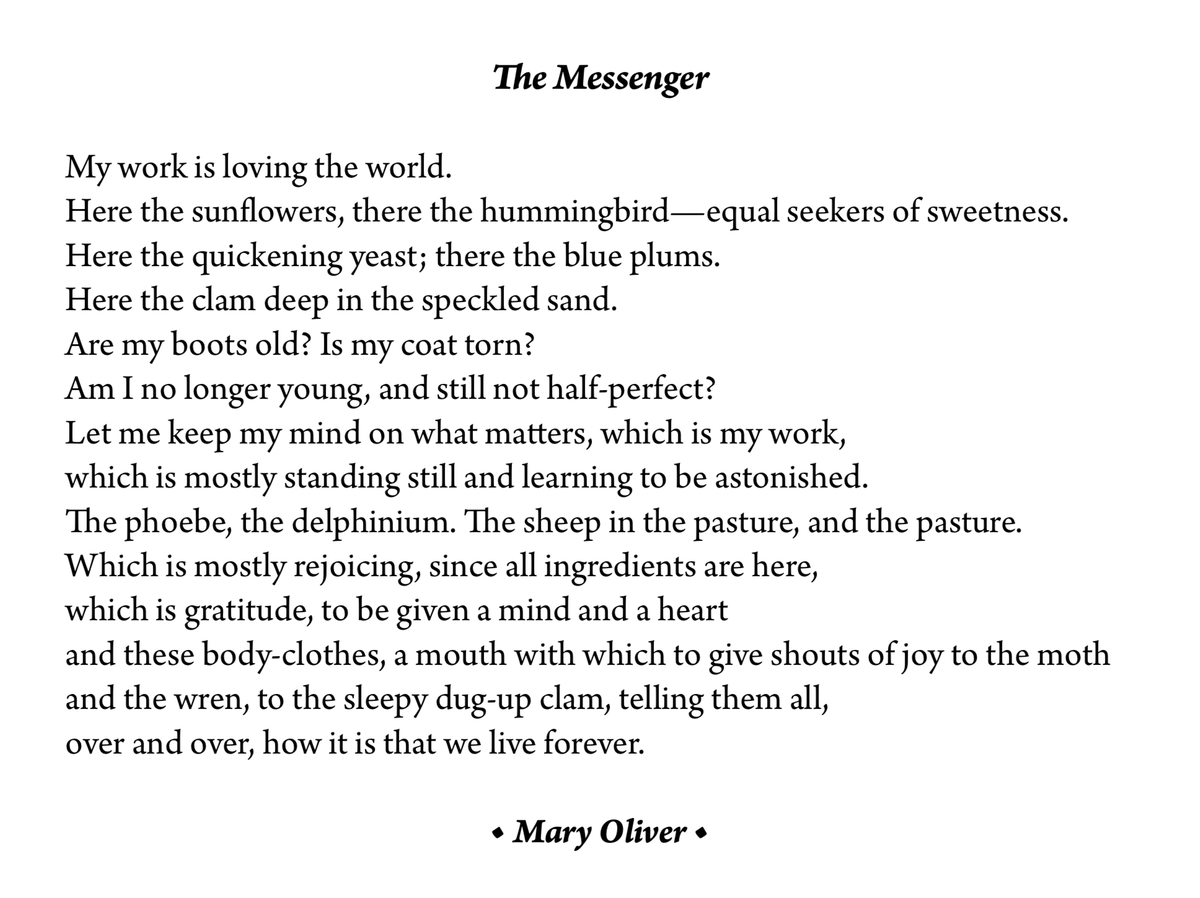
“Are my boots old? Is my coat torn? Am I no longer young, and still not half-perfect?”
The opposite of noticing the small annoyances or gratuities people take from me each day would be to practice noticing generosity. Oliver seems to notice this generosity in the natural world most persistently, but as her poetry world expanded through her life to include the human people around her, her view of the gift of presence also expanded to them. In my own life, this rings with the Mr. Rogers quote that goes around whenever something tragic and overwhelming happens in the world:
“When I was a boy and I would see scary things in the news, my mother would say to me, ‘Look for the helpers. You will always find people who are helping.’”
If we expand this view, it might look like actively choosing to savor when someone helps us, or when we notice a parent laughing with a little child as their ice cream dribbles down their arm on a warm summer day. It might mean instead of noting a brief positive sense of connection from a kind text from a friend, we save that text telling us how truly good it was to see us this weekend, and respond thoughtfully other than “you too!!”, but lean in and see if there’s anything we want to reflect to them. Looking for generosity might actively be asking ourselves, “What are the things people are doing around me that are pretty considerate?” and scanning like an ISpy activity.
Like Oliver, sometimes when we can’t do this with people, it helps to scan our non-human people we are connected to. Noticing the generosity of nature could be taking a break on a bench near a river, and noticing the truly unrepeatable soundtrack of water that even the best sound machine somehow can’t compete with. It may be being glad that the geese, as much as they hiss and are so incredibly rude, are sharing their little yellow and grey babies with the world as they waddle across the park (even if they seem angry doing so…).
Without falling into requiring ourselves to only connect to positive emotions, the tool of looking for where generosity lives can make the world feel more trustworthy. At the very least, it can remind us of all those in the world we can trust, and that cares for us, even without our asking.
I will keep my annoyance on this flight. I will also notice that the flight attendant was more generous than she needed to be, and gave me two snacks instead of one. I can feel like a kid who wants to kick my feet (gently!) at the back of the chair, while simultaneously getting a text from a friend about how excited they are for our plans next week, and notice the surge of joy as much as my mind notices the surge of irritability.
I don’t wish to see things as they are not, and I don’t encourage that. But sometimes, it can be easy to stop seeing all the good, and I think we have some capacity to change that, even if just a little, even if just for the length of flight or, more realistically, for a poem.
Today’s Journal Prompt: Where have you noticed generosity today? From strangers, family, friends, or the natural world—where has something treated you with more kindness or benefit than was necessary or expected?
Today’s Tiny Challenge: Find one small way to be generous, anonymously.
Take care,
Margaret of Bad Art Every Day