
I have been familiar with Sophia Kinsella’s game since I was about 13 years old, taking the women’s lit books off my mother’s nightstand after she finished each one. Every couple of years, I come back to the movie adaptation of her most famous series, Confessions of a Shopaholic, and today, on the first day of 2025, I’m rewatching the movie to delight in and re-learn lessons I first learned from The Girl in the Green Scarf. Here are my top five lessons from moments in the movie.
We buy what we want to be, even if we know it does not work.
One of the opening scenes of the movie shows us, I think almost perfectly, what it feels like to have marketing our own internalized consumerist fantasy get activated. I can think of so many times—from when I was a 13 year old girl wanting to have the right item from American Eagle for picture day, to being 30 now and thinking the right journal or clothing item will suddenly unlock a habit or trait or way of being and is the only way there. Knowing these stories are distortions, and not as immediately and urgently true as we are taught to take them as, is a big lesson I’m still learning.
“There is no question. I have to have this scarf. I have to have it. It makes my eyes look bigger, it makes my haircut look more expensive, it makes me look like a different person. I’ll be able to wear it with everything. People will refer to me as the Girl in the Denny and George Scarf.”
We don’t have to give up the excitement of the story of an object, we just have to make the meaning ourselves, instead of mindlessly eating the one the store makes.
That being said, after we notice the stories that are sold to us and make us feel like we must buy! buy! buy!, we don’t have to give up the stories of all our objects. In fact, as y’all know from my Tik Tok writing, I LOVE a good story behind an object—so much so that I’ve coined the term “meaningful-ism” as a decor style, after the underconsumption core of the past year. The longer we have, use, mend, and reuse an object, the more meaning it has. While it’s okay to have some objects be bought with the fantasy story of it making us immediately a new sort of person, the stories that stick are the ones we enact with the object. I certainly take a sort of anthropomorphized view of objects, and think that like with those in our community, the nature around us, and with our loved ones, part of modern loneliness is the lack of lasting story, including with our objects. But we have to slow down and spend time with something to have a compelling relational story with it, and overconsumption does not allow this.
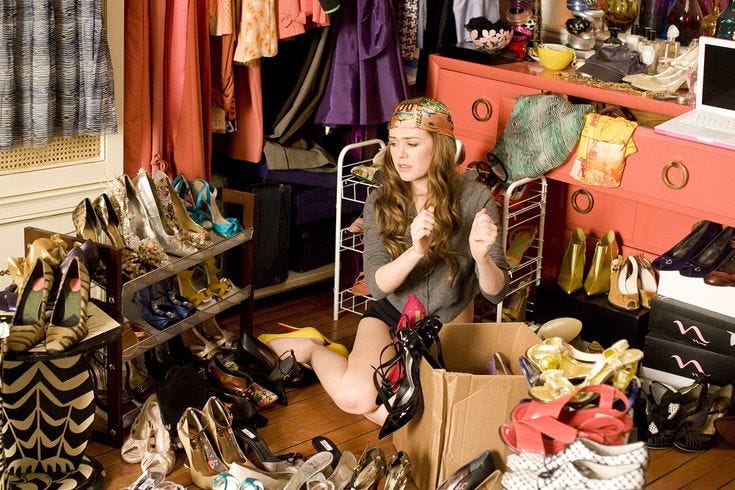
Though our environment pushes against our agency with tricks of marketing and tech, we still do have agency, and we feel better in our life when we notice that and exercise choice in consumption whenever we can.
I recently also watched the new Netflix documentary, Buy Now!, which is on online shopping in America and tricks of modern marketing to make us feel every want is a need, and the hidden underbelly of production, consumption, and waste in the world. I highly recommend, and it is quite sobering.
In the movie, there comes a point where Rebecca’s shopping becomes such a problem that it disrupts her job, her best friend’s wedding, and her relationship. In a world that loves to talk about the lack of third spaces and wish for community, a harder part to talk about is that there is a burden to the joy of community. This is okay—but part of this as a consumer is acknowledging that how we buy into the buying at all costs fallacy can impact those around us. There is not one single answer on how to navigate this, but we can hold the fact that the environment limits our understanding of ethical consumption AND we still have some choices in front of us to better care for our local and global communities.
We have to ask what the shopping and buying means to us, why we are doing it, and then slowly deal with the emotional part of it.
The idea of having a gambling addiction is an accepted thing, for the most part, in common culture. I think of addiction as a spectrum, in that there are things like some substances that, because of the intensity of their impact on certain brain processes, cause addiction more frequently in more people, and then there are varying levels across the addiction possibility spectrum, all the way to “normal” day to day things, in which the behavior itself may or may not be reinforcing.
In the movie, Rebecca attends an AA equivalent meeting for folks with a “shopping addiction.” Over the movie, it becomes clear how deeply enmeshed Rebecca’s emotional life and her shopping habit are, and the work for her becomes finding other ways that don’t disrupt her life in the way the consuming habit has. I think this is true for us, too. While a “cold turkey” approach works for some, something we know in the addiction world in mental health is a need for some folks for more gradual change. We also know that shame can become so loud, so fixed as the main emotion, that we don’t want to set people up to feel like giving up at bumps in the road. We may, in the current buying environment, need to think of change as slow and imperfect, and avoid sudden “detox” strict approaches.
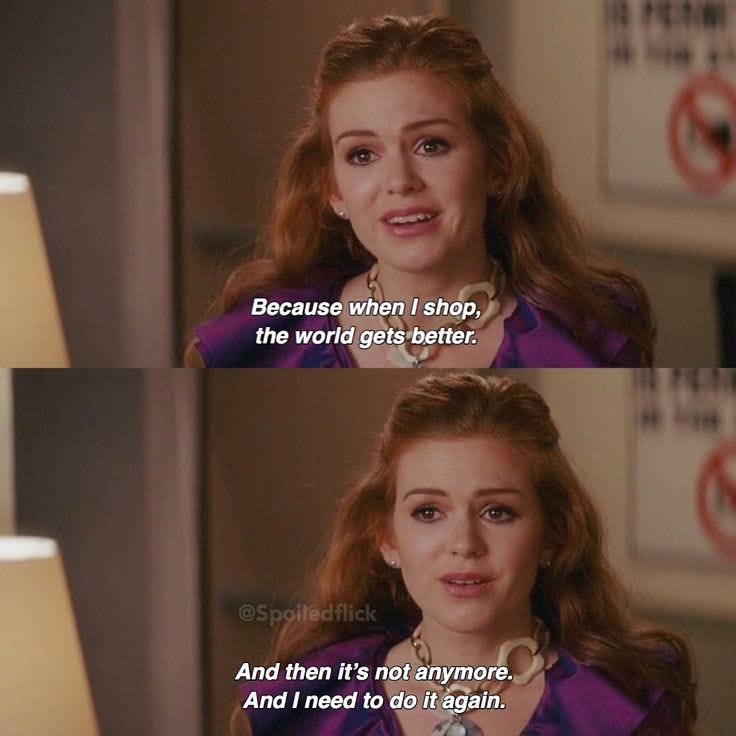
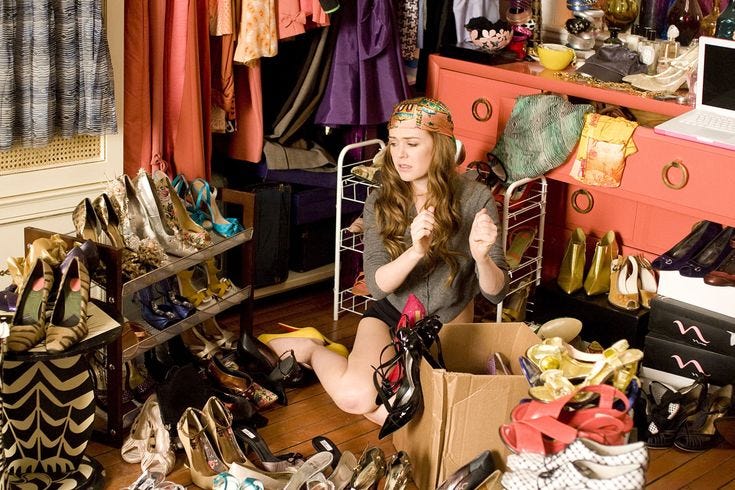
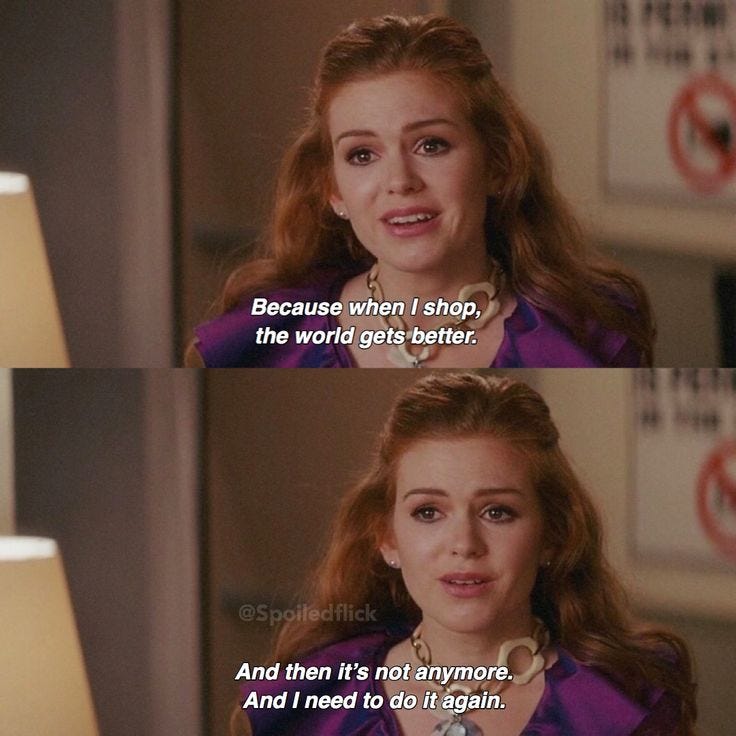
We do not need anything else to be good. We can grow with free and reused things, and the things are like props in comedy—good comedians can be funny without any props at all.
By the end of the movie, we see the Girl in the Green Scarf in the midst of growing new ways of being in the world. She doesn’t give up her love of fashion, but rather, it evolves away from being all about acquiring, and more about the styling and skill of fashion. As personal style debates rage on Substack, part of me thinks we can learn from her. We need to get offline. We need to look at what’s in our closet. We need to play dress up and put different things together. And then we need to go out into the world (feeling very much ourselves, and very much fabulous.
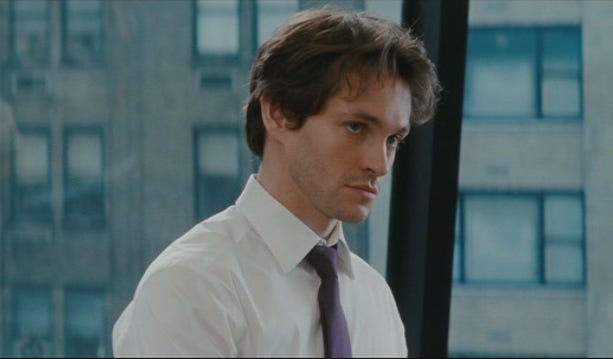
BONUS: Hugh Dancy, the MAN THAT YOU ARE!